Showing posts with label Orphan Drug. Show all posts

Monday, November 28, 2016

Drugs in Clinical Pipeline: Perifosine | Orphan Drug | AKT Inhibitor | Treatment for Cancer | Signal Transduction Pathway Inhibitor | Kinase Inhibitor


Perifosine [1,1-Dimethylpiperidinium-4-yl octadecyl phosphate] is a synthetic oral alkylphospholipid (APL) bearing a piperidine head group. APLs were shown to have selectivity for neoplastic versus normal hematologic cells in vitro

Perifosine is an oral Akt inhibitor which unlike most kinase inhibitors that target the adenosine triphosphate (ATP)-binding region, prefers binding to the Pleckstrin Homology (PH) domain of Akt, thereby preventing Akt's translocation to the plasma membrane. It also modulates a number of other key signal transduction pathways, including the JNK and MAPK pathways, all of which are pathways associated with programmed cell death, cell growth, cell differentiation and cell survival. The effects of Perifosine on Akt are of particular interest because of the importance of this pathway in the development of most cancers, with evidence that it is often activated in tumors that are resistant to other forms of anticancer therapy, and the difficulty encountered thus far in the discovery of drugs that will inhibit this pathway without causing excessive toxicity [1, 2].


Structure of Perifosine
Perifosine : 2D and 3D Structure


Perifosine is based on the structure of lysophosphatidylcholine and belongs to lysolecithin analogues class of antitumor APLs that also includes Edelfosine and Miltefosine.

Friday, October 21, 2016

Drugs in Clinical Pipeline: TGR-1202 | Orphan Drug | Kinase Inhibitor | Phosphoinositide 3-kinase delta (PI3Kδ) Inhibitors | Cancer Drug


TGR-1202 [(S)-2-(1-(4-amino-3-(3-fluoro-4-isopropoxyphenyl)-1H-pyrazolo[3,4-d]pyrimidin-1-yl)ethyl)-6-fluoro-3-(3-fluorophenyl)-4H-chromen-4-one] is a potent, orally available, small molecule selective phosphoinositide 3-kinase (PI3K) delta (PI3Kδ;  IC50 = 22.23 nM) kinase inhibitor with high selectivity over all other PI3K isoforms (48 – 10000 times) as well that for a 441-kinase panel. The selectivity and activity of TGR-1202 is credited to its design with a unique backbone compared to other PI3K inhibitors in development [1, 2].

Structure for TGR-1202
TGR-1202 : 2D and 3D Structure

TGR-1202 is currently under clinical development for patients with relapsed and refractory hematological malignancies.
On Aug 24, 2016 TG Therapeutics, Inc. announced that the U.S. Food and Drug Administration (FDA) has granted orphan drug designation for the oral, next generation PI3K-delta (PI3Kδ) inhibitor, TGR-1202, in the treatment of patients with Chronic Lymphocytic Leukemia (CLL).

Tuesday, August 30, 2016

Eltrombopag | Thrombopoietin Receptor (TpoR) Agonist | Treatment for Chronic Immune (Idiopathic) Thrombocytopenic Purpura (ITP)

Eltrombopag [3'-{(2Z)-2-[1-(3,4-dimethylphenyl)-3-methyl-5-oxo-1,5-dihydro-4H-pyrazol-4-ylidene]hydrazino}-2'-hydroxy-3-biphenylcarboxylic acid] is a first-in-class, orally available thrombopoietin-receptor (TpoR) agonist developed as treatment for conditions characterized by thrombocytopenia. Eltrombopag stimulates megakaryocyte proliferation and differentiation [1].

The activity of Eltrombopag is dependent on expression of the TpoR but does not compete with endogenous Tpo. In vitro experiments suggest that Eltrombopag interacts with TpoR at a distance from the binding site for endogenous Tpo. Thrombopoietin receptor stimulation leads to activation of the Janus kinase 2 and signal transducer and activator of transcription (STAT) 5 pathways, ultimately stimulating proliferation and differentiation of primary human CD34+ bone marrow cells into CD41+ megakaryocytes and increased platelet production. 

Eltrombopag was identified from high-throughput screening of small-molecule biarylhydrazone class of compounds collections. Eltrombopag has 1 acidic end, 1 lipophilic end and a metal chelate group in the center, designed in manner for effective biological activity [1, 2].


Eltrombopag: 2D and 3D Structure


Eltrombopag was initially approved by the U.S. Food and Drug Administration (US-FDA) on November 20, 2008, for the treatment of thrombocytopenia in patients with chronic immune (idiopathic) thrombocytopenic purpura (ITP) who have had an insufficient response to corticosteroids, immunoglobulin therapy, or splenectomy. On August 24, 2015, the FDA approved an oral suspension of Eltrombopag for the treatment of thrombocytopenia in pediatric patients 1 year and older. Prescription is currently controlled through an FDA restricted distribution system, Risk Evaluation and Mitigation Strategy (REMS), to track the long-term safety profile.

In 2010, Eltrombopag was approved in Europe for the long-term treatment of adult patients with previously treated chronic ITP.

Eltrombopag received FDA breakthrough treatment designation in February 2014 for patients with aplastic anemia for which immunosuppression has not been successful.


Eltrombopag Synthesis

WO2002057300A1: The patent reports industrial route to synthesize Eltombopag.

Intermediate 1:


Intermediate 2:


Final Synthesis:


Identifications:

1H NMR (Estimated) for Eltrombopag

Experimental: 1H NMR (300 MHz, d-DMSO) δ 13.76 (s, 1H), 13.12 (s, 1H), 9.70 (s, 1H), 8.14 (s, 1H), 7.97 (dd, J = 7.7 Hz, 1H), 7.81 (dd, J = 7.7 Hz, 1H), 7.74-7.60 (m, 5H), 7.22-7.13 (m, 3H), 2.34 (s, 3H), 2.27 (s, 3H), 2.23 (s, 3H).


Sideeffects: The principal nonclinical toxicology findings associated with Eltrombopag administration include cataracts, renal toxicity and hepatotoxicity.
No serious adverse events were reported during both the clinical trials in patients with ITP and thrombocytopenia associated with HCV-related cirrhosis. The rate of adverse events(AEs) did not differ among those who received the active drug and those who received placebo, and were not dose related. Headache has been consistently the most frequently reported adverse event in all Eltrombopag trials. Other reported AEs (less than 2%) are fatigue, nausea, vomiting, diarrhea, nasopharyngitis, arthralgia, increased alanine aminotransferase, upper respiratory tract infection and urinary tract infection.
In accordance with the boxed warning, serum liver enzymes and liver function tests should be performed on all patients before initiation of therapy, every 2 weeks during dose titration and monthly after establishment of a stable dose. A reduced starting dose of 25 mg is recommended for patients with moderate- to-severe liver disease. 
The mechanism of action of Eltrombopag and preclinical data in rodent models suggested a potential risk of bone marrow fibrosis in humans. From the interim analysis of the EXTEND study, 23 out of 44 patients treated with Eltrombopag for longer than 1 year demonstrated some degree of fibrosis (20 reticulin and 3 collagen). Cytopenia was not reported in any of the 44 patients.

Thursday, June 16, 2016

Osimertinib | Mutant Selective EGFR Inhibitor | Kinase Inhibitor | Orphan Drug | Treatment for NSCLC

Osimertinib [N-[2-[2-(dimethylamino)ethyl-methylamino]-4-methoxy-5-[[4-(1-methylindol-3-yl)pyrimidin-2-yl]amino]phenyl]prop-2-enamide] is an oral, small molecule, irreversible and mutant-selective inhibitor of epidermal growth factor receptor (EGFR) kinase activity. Chemically, Osimertinib is a mono-anilino-pyrimidine compound that is structurally and pharmacologically distinct from all other third-generation tyrosine kinase inhibitors (TKIs) including CO-1686 and WZ4002 [1, 2].


Osimertinib: 2D and 3D Structure

Osimertinib is designed in such a manner that it irreversibly and selectively targets both sensitizing and resistant-T790M mutant EGFR whilst harboring less activity towards wild-type EGFR. Osimertinib has been developed to target the EGFR T790M mutation that is often present in NSCLC patients with acquired EGFR TKI resistance, while sparing wild-type EGFR. 

Osimertinib was granted US FDA breakthrough therapy designation, orphan drug status and fast track status for non-small cell lung cancer (NSCLC) in 2014, and was granted US FDA priority review designation by early September 2015. In May 2015, Osimertinib was granted accelerated assessment status in the same indication in the EU, and received priority review status in Japan in the third quarter of 2015. 

Osimertinib has been designed to target the EGFR T790M mutation that is often present in NSCLC patients with acquired EGFR TKI resistance, while sparing wild-type EGFR. In November 2015, the tablet formulation of osimertinib was granted accelerated approval in the USA for the treatment of patients with metastatic EGFR T790M mutation-positive NSCLC who have progressed on or after EGFR TKI therapy [1].


Dosages and Approvals:
In Nov 2015, Osimertinib (Tradename: Tagrisso) a third-generation EGFR TKI that targets tumours with certain EGFR mutations, including T790M,got an  accelerated approval from the US FDA for the treatment of patients with metastatic EGFR T790M mutation-positive NSCLC (as detected by an FDA-approved test) who have progressed on or after EGFR TKI therapy.
The recommended dosage of Osimertinib is 80 mg once daily until unacceptable toxicity or disease progression (PD). Osimertinib tablets (available as 40 and 80 mg) can be taken with or without food, or in patients who have difficulty swallowing solids, dispersed in about 50 mL of noncarbonated water and immediately consumed or administered via nasogastric tube. 
A joint effort of AstraZeneca and University of Cambridge since 2014 is credited with discovery of Osimertinib, where the university’s researchers gain access to key compounds from AstraZeneca’s investigation pipeline, including Osimertinib. In October 2015, AstraZeneca entered into a collaborative agreement with Eli Lilly to investigate the use of Osimertinib as combination therapy (with Ramucirumab or Necitumumab) in patients with solid tumours.


Osimertinib Synthesis

J Med Chem 2014, 57(20), 8249-8267: It is one of the earliest reported synthetic route for Osimertinib. The article details the design, discovery and activity of Osimertinib and its various analogues.

Starting Material (Route 1):

Route 2: Shorter with better yields too !!!
 

Final Synthesis:


Identifications:


1H NMR (Estimated) for Osimertinib


Experimental: 1H NMR (400 MHz, DMSO, 22 °C) δ 2.21 (6H, s), 2.29 (2H, t), 2.72 (3H, s), 2.89 (2H, t), 3.86 (3H, s), 3.92 (3H, s), 5.77 (1H, dd), 6.27 (1H, dd), 6.43 (1H, dd), 7.04 (1H, s), 7.15 (1H, t), 7.2-7.27 (2H, m), 7.53 (1H, d), 7.91 (1H, s), 8.24 (1H, d), 8.33 (1H, d), 8.68 (1H, s), 9.14 (1H, s), 10.22 (1H, s).
13C-NMR (Estimated) for Osimertinib

Experimental: 13C NMR (176 MHz, DMSO, 22 °C) δ 32.8, 42.6, 45.1, 55.7, 56.0, 56.8, 105.3, 107.1, 110.4, 112.4, 113.3, 120.8, 121.2, 121.9, 125.3, 125.5, 125.9, 127.7, 132.4, 133.8, 137.3, 137.7, 145.8, 157.6, 158.9, 159.8, 161.5, 162.3.


Sideeffects: The most common adverse events (AEs) of any grade with Osimertinib (occurring with greater than 20 % incidence) were diarrhea (47 %), rashes and acne (group term; 40 %), nausea (22 %), decreased appetite (21 %) and dry skin (20 %). The incidences of some adverse events, including diarrhoea and rash, increased in a dose-dependent fashion.
Based on clinical trial data, the US prescribing information for Osimertinib carries warnings and precautions regarding the increased risk of ILD/pneumonitis, QTc interval prolongation and cardiomyopathy during treatment.

Results from clinical trials reveal that pneumonitis-like events were reported in six patients (2.4 %), all of whom stopped treatment and had resolved or were resolving at the time of analysis. Eleven patients (4.3 %) experienced prolongation of QTc interval and six patients (2.4 %) reported hyperglycaemia during Osimertinib treatment; none of these patients required dosage reduction or drug discontinuation. Of the seven fatal adverse events with Osimertinib, one case of pneumonia was considered to be possibly treatment-related.

References:
1. Greig, S. L. Osimertinib: First Global Approval. Drugs 2016, 76(2), 263-73. (FMO only)
2. Finlay, M. R.; et. al. Discovery of a potent and selective EGFR inhibitor (AZD9291) of both sensitizing and T790M resistance mutations that spares the wild type form of the receptor. J Med Chem 2014, 57(20), 8249-67. (FMO only)

Tuesday, May 24, 2016

Ataluren | Treatment for Duchenne Muscular Dystrophy | Orphan Drug | Treatment of Nonsense Mutation

Ataluren [3-[5-(2-Fluorophenyl)-1,2,4-oxadiazol-3-yl]benzoic acid] is an orally available, small molecule compound that targets nonsense mutation. It is the first drug in its class and appears to allow cellular machinery to read through premature stop codons in mRNA, and thus enables the translation process to produce full-length, functional proteins.

Ataluren is developed and approved for the treatment of nonsense mutation Duchenne muscular dystrophy (nmDMD) by EU in July 2014 [1].

Ataluren: 2D and 3D Structure

Nonsense Mutations as Target for DMD
A single nucleotide change in the DNA sequence that introduces a premature stop codon is known as a nonsense mutation, a subset of a major class of premature termination codon (PTC) mutations. Nonsense mutations cause premature termination of translation resulting in the production of truncated polypeptides, which in turn halts the ribosomal translation process at an earlier site than normal, producing a truncated, non-functional protein [1]. 
Nonsense mutations are implicated in 5-70 % of individual cases of most inherited diseases, including Duchenne muscular dystrophy (DMD) and cystic fibrosis. Ataluren appears to allow cellular machinery to read through premature stop codons in mRNA, enabling the translation process to produce full length, functional proteins.

Ataluren Synthesis
New J Chem 2014,38, 3062-3070: The text reports one pot synthesis of Ataluren with an overall yield of 40%. It also reports few interesting and potent derivatives too.


WO2007117438A2: It appears to be the industrial process. The patent also reports various pharmaceutically relevant assay and their results wrt Ataluren.


Identifications:
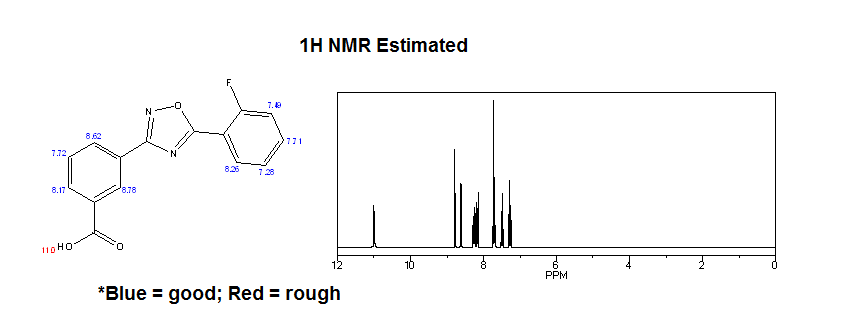
1H NMR (Estimated) for Ataluren

Experimental: 1H NMR (d6-DMSO, 400 MHz) δ 13.15-13.68 (bs, 1H), 8.62 (s, 1H), 8.31 (d, 1H, JHH = 6.8 Hz), 8.24 (t, 1H, JHH = 7.2 Hz), 8.17 (d, 1H, JHH = 7.4 Hz), 7.77-7.82 (m, 1H), 7.73 (t, 1H, JHH = 7.6 Hz), 7.53 (dd, 1H, JHH = 10.8 Hz, JHH = 8.4 Hz), 7.48 (t, 1H, JHH = 6.8 Hz).


13C-NMR (Estimated) for Ataluren

Experimental: 13C NMR (d6-DMSO, 400 MHz) δ 172.72 (d, JCF = 4.4 Hz), 167.39, 166.52, 159.95 (d, JCF = 258.0 Hz), 135.80 (d, JCF = 8.8 Hz), 132.28, 131.97, 131.97, 131.04, 130.94, 129.86, 127.76, 125.4 (d, JCF = 3.6 Hz), 117.2 (d, JCF = 20.4 Hz), 111.6 (d, JCF = 11.2 Hz).


Sideeffects: The most common side effects reported during Ataluren therapy were headache, nausea and vomiting. Most Ataluren-associated adverse events were of mild or moderate severity and Ataluren had a similar adverse event profile to placebo. Side effects did not appear to be dose dependent.
Ataluren should not be co-administered with intravenous aminoglycosides because of the risk of decreased renal function.

References:
1. Ryan, N. J. Ataluren: first global approval. Drugs 2014, 74(14), 1709-14. (FMO only)
2. Gupta, P. K.; et. al. A metal-free tandem approach to prepare structurally diverse N-heterocycles: synthesis of 1,2,4-oxadiazoles and pyrimidinones. New J Chem 2014, 38, 3062-3070 (FMO only)
3. Almstead, N. G.; et. al. Methods for the production of functional protein from dna having a nonsense mutation and the treatment of disorders associated therewith. WO2007117438A2

Wednesday, November 11, 2015

Drugs in Clinical Pipeline: AM-111

AM-111 (D-JNKI-1 gel for intratympanic injection) is a 31-amino acid cell-permeable peptide, formulated in a biocompatible hyaluronic acid gel that is being developed for topical treatment of acute inner ear (sensorineural) hearing loss (ASNHL). AM-111 contains the synthetic peptide D-JNKI-1 (D-stereoisomer of c-Jun N-terminal Kinase Inhibitor 1), an inhibitor of the JNK stress kinase coupled to an intracellular transporter. D-JNKI-1 is formulated in a biocompatible and fully biodegradable gel. It is administered by a single dose intratympanic injection into the middle ear. From there the drug diffuses through the round window membrane into the cochlea.


AM-111 contains the synthetic peptide H-D-Asp-D-Gln-D-Ser-D-Arg-D-Pro-D-Val-D-Gln-D-Pro-D-Phe-D-Leu-D-Asn-D-Leu-D-Thr-D-Thr-D-ProD-Arg-D-Lys-D-Pro-D-Arg-D-Pro-D-Pro-D-Arg-D-Arg-D-Arg-D-Gln-D-Arg-D-Arg-D-Lys-D-Lys-D-Arg-D-Gly-NH2.

AM-111’s effector domain has been derived from the scaffold protein islet-brain 1, which retains c-Jun N-terminal kinase (JNK) in the cytoplasm; it is coupled to the trans-activator of transcription (TAT) protein transduction domain. JNK is a member of the stressactivated group of mitogen-activated protein kinases involved in apoptosis after extracellular stress insults and inflammation. Its inhibition prevents formation of transcription complexes and further progress along the apoptotic pathway or activation of genes, which are encoding inflammatory molecules.

AM-111 received orphan drug designation from both EMA (June 2005) and US-FDA (April 2006) for the treatment of ASNHL. AM-111 has the potential to become the first approved pharmaceutical treatment for ASNHL.


AM-111's otoprotective effect has been demonstrated in various animal models of cochlear stress, including acute acoustic trauma, acute labyrinthitis (inflammation), drug ototoxicity (aminoglycosides), bacterial infection, cochlear ischemia and cochlear implantation trauma. 


Common Name: AM-111
Synonyms: AM-111; AM111; AM 111; D-JNKI-1; XG-102; XG102; XG 102; AM111 peptide; XG102 peptide
IUPAC Name: 
CAS Number: 
Mechanism of Action: Kinase Inhibitor; JNK Inhibitor; c-Jun N-terminal Kinase Inhibitor
Indication: Treatment of Sensorineural Hearing Loss; Cardiovascular Therapy; Eye disorder Therapy; Neuroprotectants
Development Stage: Phase III
Company: Auris Medical/Xigen

References:
1. Suckfuell, M.; et. al. Efficacy and safety of AM-111 in the treatment of acute sensorineural hearing loss: a double-blind, randomized, placebo-controlled phase II study. Otol Neurotol 2014, 35(8), 1317-1326.

Thursday, October 29, 2015

Drugs in Clinical Pipeline: ABTL0812

ABTL0812 [sodium 2-hydroxylinoleate] is an orally available lipid analogue that hits two clinically validated targets: mTOR and DHFR.  Both these clinically validated targets are responsible for the cytotoxic effect of ABTL0812: mTOR (mammalian target of rapamycin), as shown by the dramatic reduction in S6 phosphorylation, and dihydrofolate reductase (DHFR), as shown by its reduced expression, resulting in autophagic cell death. Moreover, the compound's cellular potency increases with incubation time, and it has a long lasting cytotoxic effect after removing the compound from the incubation medium. This multi-target property increases antitumor efficacy and reduces drug resistance. In addition, preliminary in vivo results indicate that the potential therapeutic margin will be high [1].

ABTL0812 has cytotoxic effect on a wide range of human tumor cell lines, including those which have become resistant to standard therapy. ABTL0812 molecular targets were identified by in silico analysis, comparing ABTL0812 chemical structure against a database including more than one million receptor-ligand interaction data. Functional relevance of the targets was confirmed biochemically and pharmacologically. ABTL0812 mechanism of action was established using human lung and pancreatic tumor cells, MEF KO cells, as well as tumor xenografts.

In silico screening showed that ABTL0812 binds four targets which regulate tumor progression through Akt/mTOR axis. Two of them are the transcription factors PPARα and PPARγ (Peroxisome-Proliferator Activating Receptors). In lung and pancreatic tumor cells ABTL0812 activated PPARα/γ-dependent gene transcription, while pharmacological inhibition with PPARα/γ antagonists impaired ABTL0812 cytotoxic effect. Interestingly, ABTL0812 induced transcription of the endogenous Akt inhibitor TRIB3 (tribbles homologue 3) through PPARα/γ activation. TRIB3 is a pseudokinase that inhibits Akt by direct binding and preventing its phosphorylation by mTORC2 complex. According to this, ABTL0812-induced TRIB3 overexpression resulted in inhibition of Akt phosphorylation, impaired phosphorylation of the Akt substrates TSC2 and PRAS40 and mTORC1 inhibition (pS6), which in turn promoted autophagy-mediated tumor cell death. MEF TRIB3-/- cells were resistant to ABTL0812-induced cell death, indicating that TRIB3 mediates ABTL0812 cytotoxicity. Finally, Akt inhibition was observed in human lung and pancreatic tumor xenograft models treated with ABTL0812 and in human platelets incubated with ABTL0812. This supported the rational for using Akt phosphorylation as a pharmacodynamic biomarker to monitor activity of ABTL0812 in patients included in the Clinical Trial [2].

ABTL0812 was originally developed by Lipopharma and has been licensed to Ability Pharmaceuticals. In Aug 2015 Ability Pharmaceuticals, received orphan drug designation from the U.S. FDA for ABTL0812 in the treatment of neuroblastoma.  The European Medicines Agency (EMA) granted ABTL0812 orphan drug status in April 2015 for the same indication. Neuroblastoma is a rare type of cancer originated from nerve cells and is the most common solid tumor outside the brain in children.  The prognosis for high-risk neuroblastoma cases is poor with no effective treatment.


Common Name: ABTL0812
Synonyms: ABTL0812; ABTL 0812; ABTL-0812
IUPAC Name:  Sodium 2-hydroxylinoleate
CAS Number: -
SMILES:
Mechanism of Action: Kinase Inhibitor; MTOR Inhibitor; AKT Inhibitor; DHFR Inhibitor; Dihydrofolate Reductase Inhibitor
Indication: Various Cancers; Treatment of Neuroblastoma
Development Stage: Phase I
Company: Lipopharma/Ability Pharma

References:
1. Alfon, J.; et. al. Abstract 922: ABTL0812: A new drug class with oral antitumor action inhibiting mTOR activity and DHFR expression. Cancer Res 2012, 72, 922.
2. Gomez-Ferreria, M.; et. al. Abstract 672: ABTL0812, a new antitumor drug that inhibits the axis Akt/mTOR through a novel mechanism of action. Cancer Res 2015, 75, 672.
3. Escriba, R. P. V.; et. al. Use of polyunsaturated fatty acid derivatives as medicaments WO2010106211A1

Thursday, October 15, 2015

Drugs in Clinical Pipeline: KH-176

KH-176 [(S)-6-hydroxy-2,5,7,8-tetramethyl-N-((R)-piperidin-3-yl)chroman-2-carboxamide] is a potent intracellular redox modulating agent targeting the reactive oxygen species which are important in the pathogenesis of disorders of mitochondrial oxidative phosphorylation. KH0176 is an orally bio-available small molecule developed by Khondrion for the treatment of mitochondrial myopathy, encephalopathy, lactacidosis, and stroke (MELAS) syndrome and other mitochondrial respiratory chain/oxidative phosphorylation (OXPHOS) diseases.

KH-176 is capable of reducing intracellular reactive oxygen species (ROS) in cells. The compound was tested for its effect on decreasing the intracellular ROS levels in a patient cell line (S7-5175 cells, which are fibroblasts from a patient with a mutation in the NDUFS7 gene) with increased ROS levels, in a DCFDA assay. KH-176 reported an EC50 value in the range 0.1 - 1 uM.

In August, 2015 Khondrion, the Dutch biopharmaceutical company focusing on small molecule therapeutics for mitochondrial diseases, announced that the European Commission has granted Khondrion Orphan Drug Designation (ODD) for its front-runner compound KH-176 to treat mitochondrial myopathy, encephalopathy, lactacidosis, and stroke (MELAS) syndrome.

The European Commission has already granted KH-176 an ODD for treatment of the mitochondrial disease, Leigh syndrome. The US Food and Drug Administration (FDA) granted KH-176 an ODD for all inherited mitochondrial respiratory chain disorders. KH-176 is currently being evaluated in randomized, double blind, placebo-controlled dose-escalating studies in healthy volunteers in Phase 1 Clinical Trials.


Mitochondria and its dysfunction

Mitochondria are essential organelles that constitute the 'powerhouses' of the cell. Defects in these organelles often lead to a variety of severe metabolic disorders affecting the organs that have a high-energy demand, such as muscle and brain. With an incidence of at least 1 in 5000 individuals it is recognized as the most common group of inborn errors of metabolism. Moreover, because programmed cell death (apoptosis) is triggered by mitochondria, defects in these organelles have consequences far beyond the diseases, which brought them initially to our attention and involvement in cancer and neurodegenerative diseases like Alzheimer and Parkinson has been demonstrated. Many commonly used drugs like the RTIs, certain antibiotics and anti-epileptic drugs, may cause mitochondrial dysfunction. So far no effective treatment is available to cure or improve these disease conditions.

One of the primary functions of mitochondria is oxidative phosphorylation (OXPHOS). The contribution of mitochondrial dysfunction to human disease was already recognized in the late 1980s, when maternally inherited point mutations, as well as deletions arising spontaneously during development, were found to be associated with rare neurological syndromes. Mitochondrial dysfunction contributes to various disease states. Some mitochondrial diseases are due to mutations or deletions in the mitochondrial genome. If a threshold proportion of mitochondria in the cell is defective, and if a threshold proportion of such cells within a tissue have defective mitochondria, symptoms of tissue or organ dysfunction can result. Practically any tissue can be affected, and a large variety of symptoms may be present, depending on the extent to which different tissues are involved. Some examples of mitochondrial diseases are Friedreich's ataxia (FRDA), Leber's Hereditary Optic Neuropathy (LHON), dominant optic atrophy (DOA); mitochondrial myopathy, encephalopathy, lactacidosis, and stroke (MELAS), Myoclonus Epilepsy Associated with Ragged-Red Fibers (MERRF) syndrome, Leigh syndrome, and oxidative phosphorylation disorders. Most mitochondrial diseases involve children who manifest the signs and symptoms of accelerated aging, including neurodegenerative diseases, stroke, blindness, hearing impairment, diabetes, and heart failure [1].

Very few treatments are available for patients suffering from these mitochondrial diseases.

References:
1. Blaauw, R. H.; et. al. Chromanyl derivatives for treating mitochondrial disease. WO2014011047A1

Drugs in Clinical Pipeline: BMS-204352 | Orphan Drug | Fragile X Treatment

BMS-204352 {[3S]-[+]-[5-chloro-2-methoxyphenyl]- 1,3-dihydro-3-fluoro-6-[trifluoromethyl]-2H-indol- 2-one}, a novel fluorooxindole maxi-K channel opener, was being developed for the treatment of stroke.


BMS-204352: 2D and 3D Structure
The compound is highly potent and specific for the target site of action and has been shown to be efficacious for therapy of acute forms of stroke after intravenous dosing in animal stroke models [1]. BMS-204352 went up to phase III trial for the treatment of acute ischemic stroke but failed to show improvement against placebo. However during trials no organ toxicity or adverse effects were found [2].

The European Medicines Agency (EMA) has granted "orphan designation" to BMS-204352, a molecule being developed by the CNRS to treat Fragile X Syndrome, a rare genetic disease for which there exists no treatment.

Common Name: BMS-204352
Synonyms: BMS-204352; BMS204352; BMS 204352; Flindokalner
IUPAC Name: (3S)-(+)-(5-chloro-2-methoxyphenyl)-1,3-dihydro-3-fluoro-6-(trifluoromethyl)-2H-indol-2-one
CAS Number: 187523-35-9
SMILES: COc1ccc(Cl)cc1[C@@]1(F)C(=O)Nc2cc(ccc12)C(F)(F)F
Mechanism of Action: Maxi-K Channel Opener
Indication: Treatment of Strokes; Treatment of Fragile X Syndrome
Development Stage: Phase I
Company: Bristol Meyer Squibb/CNRS


1H NMR (Estimated) for BMS-204352

Fragile X syndrome is a rare disorder produced by mutations in the Fragile X mental retardation 1 gene, which result in abnormal neuropsychologic development. It manifests clinically with autism, intellectual disability, attention-deficit hyperactivity disorder and muscle hypotonia [3]. Fragile X Syndrome (FXS) is the most common cause of inherited mental deficiency and is associated with autistic features. FXS is caused by a CGG triplet expansion in the FMR1 gene resulting in the absence of its coding protein, Fragile X Mental Retardation Protein (FMRP). This mRNA-binding protein regulates both localization and translation of specific mRNAs in synaptic regions, but also controls synaptic membrane proteins activity through a translation-independent pathway. As a consequence of this synaptic disturbance, a preponderance of long, thin and tortuous dendritic spines in cortex is observed in FXS patients brain. Fmr1 knock-out (KO) mouse, a murine model of human FXS, presents both dendritic spines maturation abnormalities and many behavioral characteristics similar to human FXS, including altered social interaction, occurrence of repetitive behaviors, hyperactivity and cognitive dysfunction [4].

Recent studies have demonstrated the implication of potassium channels in FXS pathology. Among them, large-conductance Ca2+-activated K+ channels (BKCa channels, also known as BK or Maxi-K channels), activated by membrane depolarization and increased intracellular Ca2+ concentration, are of particular interest because of their control of Ca2+ concentration in neurons and regulation of neurotransmitter release such as glutamate. Several data provide convincing evidence that this channel is closely linked to behavioral and cognitive disorders. Physical mapping of balanced chromosomal aberrations revealed a KCNMA1 gene disruption in a subject with autism and intellectual deficiency. This gene haploinsufficiency induced a functional defect of BKCa channels that might contribute to neurological symptoms. In addition, a mutation in the CRBN gene, an upstream regulator of BKCa channel, has been also associated with autosomal recessive non-syndromic mental retardation.The existing therapies are focused on the alleviation of the psychiatric symptoms. More recently, compounds have been evaluated as potential therapies for this condition for ex. BMS-204352 a maxi-K channel opener [4].

References:
1. Krishna, R.; et. al. In Vitro Protein Binding Studies with BMS-204352: Lack of Protein Binding Displacement Interaction in Human Serum. Biopharm Drug Dispos 2001, 22, 41-44.
2. Jensen, B. S.; et. al. BMS-204352: a potassium channel opener developed for the treatment of stroke. CNS Drug Rev 2002 Winter, 8(4), 353-360.
3. Mclennan, Y.; et. al. Fragile x syndrome. Curr Genomics 2011, 12(3), 216-224.
4. Briault, S.; et. al. Rescue of fragile X syndrome phenotypes in Fmr1 KO mice by a BKCa channel opener molecule. Orphanet J Rare Dis 2014, 9, 124.
5. Feng, X.; et. al. Highly Enantioselective Fluorination of Unprotected 3-Substituted Oxindoles: One-Step Synthesis of BMS 204352 (MaxiPost). J Org Chem 2012, 77(20), 9148-9155.
6. Hewawasam, P. et. al. The synthesis and characterization of BMS-204352 (MaxiPost) and related 3-fluorooxindoles as openers of maxi-K potassium channels. Bioorg Med Chem Lett 2002, 12(7), 1023-1026.
7. Cahard, D.; et. al. Enantioselective synthesis of BMS-204352 (MaxiPost™) using N-fluoroammonium salts of cinchona alkaloids (F–CA–BF4). Org Biomol Chem 2003,1, 1833-1834.

Monday, September 28, 2015

RPI-78M: From Cobra Venom to Orphan Drug

RPI-78M is a modified anticholinergic alpha-neurotoxin peptide that was originally derived from an extract of cobra venom and is an antagonist of the nicotinic acetylcholine receptor. It is expected that RPI-78M may be beneficial in neuromuscular disorders where the activity of nicotinic acetylcholine receptor has been compromised. RPI-78M is being developed for the treatment of multiple sclerosis (MS). Other neurological disorders that may be served by RPI-78M include myasthenia gravis (MG), muscular dystrophy (MD) and amyotrophic lateral sclerosis (ALS).

Cobratoxin, a neurotoxin obtained from the venom of the Thailand cobra, has demonstrated several pharmacological activities that strongly support its use in this application. By employing a chemical detoxification step, the neurotoxin was rendered safe for administration to humans with minimal side effects. In a early reporet study, this modified neurotoxin demonstrated neuromodulatory, antiviral, and analgesic activity, elements associated with the multiple sclerosis condition. Modified cobratoxin demonstrated potent immunosuppressive activity in acute and chronic animal models of the disease. Following the positive signs, the drug was shortlisted for use in adrenomyeloneuropathy and clinical trials in Multiple sclerosis were planned [1].

Salient Features about RPI-78M

a: It lacks measurable toxicity. The binding with receptor is excellent suggesting that patients cannot overdose.

b: It has displayed no serious adverse side effects following years of investigations in humans and animals.

c: It extremely stable and resistant to heat, which gives the drugs a long shelf life. The drugs' stability has been determined to be over 4 years at room temperature. This is extremely unusual for a biologic drug.

d: RPI-78M can be administered orally-a first for a biologic MS drug. This will present MS patients with additional quality of life benefits by eliminating the requirement for routine injections.

On Sept 08, 2015 Nutra Pharma Corporation announced today that they have received Orphan Drug designation from the US-FDA for the Company's RPI-78M drug candidate for the treatment of Multiple Sclerosis in children.

RPI-78M induces interleukin 27 (IL27) and gamma-interferon, and it is in Phase III testing for Adrenoleukodystrophy and for additional diseases such as multiple sclerosis and herpes virus infection in earlier phases. IL27 has also been associated with inflammatory bowel disease, including Crohn's disease. Moreover, it has been shown that treatment with IL-27 reduces experimental colitis through the suppression of several inflammatory cytokines including IL- 17. In this situation, human genetic and animal studies converge to support inflammatory bowel disease and Crohn's disease specifically as new indications for RPI-78M [2].

References:
1. Reid, P. F. Alpha-cobratoxin as a possible therapy for multiple sclerosis: a review of the literature leading to its development for this application. Crit Rev Immunol 2007, 27(4), 291-302.
2. Reid, P. F.; et. al. Modified anticholinergic neurotoxins as modulators of the autoimmune reaction. US8034777B2